

The Risk Most SBA Buyers Don’t Put in the Model
Buyers diligence earnings, customers, and debt service for weeks. Far fewer model what a failed deal could cost their personal balance sheet.
By Chris Barrett, CPA · Founder and Managing Director, Midwest CPA
SBA 7(a) financing has made business ownership accessible to thousands of acquisition entrepreneurs. It can provide meaningful leverage, long amortization, and a capital structure that would be difficult to replicate with conventional financing.
That can create extraordinary upside for the right operator buying the right business.
But the same structure comes with an important tradeoff: the personal guarantee.
Buyers often spend weeks diligencing normalized earnings, customer concentration, working
capital, margins, capex, and debt service coverage. They should put the same rigor into
understanding what a failed deal could mean for their personal balance sheet.
A good acquisition model should show both sides of the distribution: what success could create
and what failure could cost.
The Diligence Everyone Runs, and the Model Almost Nobody Builds
Under SBA rules, individuals who own 20% or more of the borrower generally must provide an unlimited personal guarantee.
That does not mean a $2.5 million loan automatically creates a $2.5 million personal loss if the business fails. The business may still have cash, receivables, inventory, equipment, real estate, or other value that can be recovered and applied against the debt.
The number that matters is the gap: what the business still owes minus what the business can return.
That gap is where the personal guarantee becomes relevant. It is also why the size of the loan alone does not tell you how much personal risk you are actually taking.
Two Different Risks Deserve Two Different Models
Most acquisition diligence answers one question:
How likely is this business to get into trouble?
Quality of Earnings, customer concentration, recurring revenue, working capital, debt service coverage, industry risk, and operating diligence all help answer it.
The personal guarantee creates a second question:
If the business does fail, how significant could the personal financial consequences be?
Those risks are related, but they are not the same.
A strong business may have a relatively low probability of failure while still creating a very large personal loss in an adverse scenario. Another buyer may face similar operating risk but have materially less personal wealth exposed.
A useful acquisition model should therefore evaluate both the probability of a bad outcome and the severity if it happens, while keeping the upside case in view.
A $2.5 Million Loan Is Not Necessarily a $2.5 Million Loss — Run the Numbers
Consider a buyer financing an acquisition with a $2.5 million SBA loan.
An illustrative downside analysis might look like this:
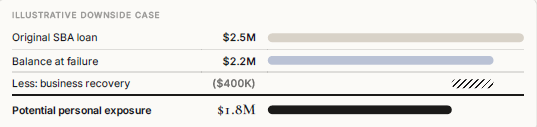
These numbers are deliberately illustrative. The right recovery assumptions depend heavily on what you are buying.
A service business whose value is primarily customer relationships and goodwill may have relatively little recoverable value if operations collapse. A distributor may have meaningful receivables and inventory. A manufacturer may have equipment. A real-estate-heavy business may have substantial hard assets.
The same loan balance can therefore create very different personal exposure depending on the business underneath it. That is one of the most important things buyers miss when thinking about the personal guarantee.
To build your own model, start with the projected outstanding principal in a severe downside scenario. Estimate what could realistically be recovered from the business using appropriately conservative assumptions. The difference gives you an approximate personal exposure to compare with your own balance sheet.
The goal is not to predict a future liquidation precisely. It is to understand whether the potential downside is closer to $250,000, $750,000, or $2 million before you sign the guarantee.
Good Diligence Is Still the First Line of Defense
The best protection against a personal guarantee claim is buying a durable business at a sensible price, financing it appropriately, preserving enough liquidity, and operating it well.
That means focusing on sustainable earnings rather than aggressive adjustments, understanding customer and vendor concentration, properly sizing working capital and maintenance capex, stress-testing debt service, and leaving enough cash after closing.
Insurance should never make a weak acquisition thesis acceptable.
But good diligence reduces the probability of failure. It does not eliminate the consequences if failure occurs.
That distinction between frequency and severity matters. Most SBA borrowers do not default. Ten-year SBA 7(a) data used in our webinar showed a 9.2% cumulative default rate across the broader program, with acquisition cohorts below the overall program average.
A low-frequency event can still deserve attention when the potential personal impact is measured in seven figures.
Most Major Business Risks Can Be Transferred. Personal Guarantees Historically Could Not.
Businesses routinely insure against property damage, liability claims, business interruption, and the loss of a key person.
A large personal guarantee has historically been different. The owner simply retained that risk personally.
That is unusual when you step back and look at it. A business may insure its building, its employees, its liability exposure, and its operations, while one of the largest risks associated with the acquisition sits directly on the owner’s personal balance sheet.
Personal Guarantee Insurance, or PGI, is a newer specialty insurance category designed to transfer a defined portion of that exposure.
The borrower still signs the guarantee. The lender’s rights do not change. The SBA loan structure does not change.
PGI does not protect the business from failing, remove the personal guarantee, or prevent lender enforcement.
Instead, it is designed to cover a defined portion of the financial exposure that remains if the business cannot satisfy the debt.
The simplest way to think about it is:
Diligence can reduce the probability of failure. PGI can reduce the severity of the personal financial outcome if failure occurs.
The Goal Is Not to Eliminate Risk. It Is to Make the Risk Proportionate to the Opportunity.
Buying a business is inherently an exercise in taking calculated risk.
A searcher may invest several hundred thousand dollars, leave a good career, and commit years of work to building the company. They already have meaningful exposure to the outcome.
The question is whether a failed acquisition should also put years or decades of wealth accumulated outside the business at risk.
For some buyers, the answer may be yes. They understand the exposure and are comfortable retaining all of it.
For others, the personal guarantee becomes the part of the transaction that feels disproportionate.
An experienced operator may be willing to invest $300,000 or $500,000 into an acquisition and accept that the equity is at risk. They may be less comfortable with a scenario where the same acquisition could create another $1 million or $2 million of personal exposure against savings, investment assets, or other wealth built over a career.
PGI can make that downside more bounded without removing the buyer’s meaningful financial exposure.
The buyer still puts their own capital at risk. The policy still includes retained risk through a deductible. And the buyer still bears the operational and financial consequences if the business struggles.
What changes is the size of the personal tail risk.
That can matter beyond the individual deal. There are experienced operators who want to buy businesses but hesitate when they see the size of the personal guarantee required to do it. A more bounded downside can make entrepreneurship accessible to people who have the skills and capital to operate a business well but are not willing to put everything they have accumulated behind one transaction.
That does not make the acquisition risk-free.
It can make the risk more rational to take.
The Calculation Can Change Again for Repeat Buyers
The same framework becomes even more important for serial acquirers.
A buyer may be comfortable with the personal exposure associated with one acquisition. But as they acquire a second or third business, the guarantees can stack.
Suddenly the relevant number is not the guarantee on any one loan. It is the aggregate personal exposure across the portfolio.
That is one of several profiles we increasingly see in the acquisition ecosystem, alongside first-time self-funded searchers, traditional searchers, and sellers who retain equity or guarantee exposure after a transaction.
For repeat buyers, modeling the personal balance sheet can become just as important as modeling the operating businesses.
Underwriting the Insurance Should Start With Underwriting the Risk
At Ink Insurance, we approach PGI from much the same perspective.
The risk ultimately begins with the underlying credit, so our underwriting looks at historical SBA loan performance, characteristics of the business and transaction, deal metrics such as debt service coverage and liquidity, and the guarantor’s personal credit profile.
For eligible SBA 7(a) borrowers, Ink can insure up to 85% of the covered loan amount, subject to underwriting and policy terms.
Other providers may structure coverage differently. Buyers should compare the actual policies rather than assume all PGI products work the same way.
Four Questions to Ask Before Buying Coverage
The headline coverage percentage is only the starting point. A buyer evaluating PGI should understand:
- What triggers a claim? Understand when the policy becomes responsive and what must happen first.
- How much risk do I retain? Review the deductible, policy limits, and other structures that determine how much exposure remains with you.
- What could prevent coverage? Read the exclusions and understand your obligations under the policy.
- How does a claim payment reduce my exposure? Understand where the proceeds go and how payment affects the remaining guaranteed debt.
A sophisticated buyer should diligence the insurance policy with the same rigor used to diligence the acquisition.
Model the Upside. Understand the Downside. Build Around Both.
People buy businesses because the upside can be extraordinary.
A successful acquisition can create independence, meaningful cash flow, long-term equity value, and an asset that compounds over years. SBA financing helps make that opportunity accessible to entrepreneurs who might otherwise need substantially more capital to buy the same business.
The personal guarantee is part of that tradeoff.
A thoughtful buyer should model both sides.
Build the upside case and understand what success could mean. Stress the operating model and understand what failure could mean. Then look at your personal balance sheet and decide how much of that downside you are comfortable retaining.
For some buyers, the answer will be all of it.
For others, transferring a portion of the risk may make sense.
The goal is not to remove the consequences of entrepreneurship. It is to take the risks that create upside without unnecessarily concentrating every possible downside on your personal balance sheet.
For the right operator and the right business, a more bounded downside can make it easier to pursue an opportunity that is otherwise worth taking.
Disclaimer
The content contained in this blog post is intended for general informational purposes only and is not meant to constitute legal, tax, accounting, or investment advice. You should consult a qualified legal or tax professional regarding your specific situation.