Tax

qualify for reps

Qualify as a Real Estate Professional and Save Thousands

Real estate professional status, commonly referred to as REPS, is a powerful tax planning strategy that can often result in thousands of dollars in savings for real estate investors. However, it is a very complicated and closely monitored portion of the tax code, so you need to be careful. Avoid taking shortcuts that may result in missing out on significant savings.

In this article I am going to give you an overview of the steps involved to qualify for real estate professional status as well as the ways it is used to save real estate professionals thousands on their tax bill.

Qualify as a Real Estate Professional and Save Thousands Read More »

bonus depreciation

Is Bonus Depreciation Going Away for Real Estate Investors?

Overview The Tax Cuts and Jobs Act of 2017 increased Bonus Depreciation from 50% to 100% for assets placed in service between September 27, 2017, and January 1st, 2023. In this article I’m going to go over what Bonus Depreciation is, what happens now that the 100% deduction has expired, and how it will affect your business. What is Bonus Depreciation? Bonus depreciation is a tax incentive created for business owners to get them to invest in their company and therefore stimulate the economy. It was first introduced back in 2002. It allows a business to accelerate depreciation by deducting a certain percentage of a fixed asset in the first year the asset was placed into service. In 2017 100% bonus depreciation was introduced. This meant a business owner could purchase qualifying property that would normally be depreciated over 5, 7, 10, 15, or 20 years could now be depreciated in a single year. This created huge tax savings potential for savvy business owners and real estate investors. What qualifies for bonus depreciation? Generally, if an asset has a depreciable life of 20 years or less it will qualify for bonus depreciation. Here is a list of assets that generally will qualify to give you an idea. Computers Equipment Furniture and fixtures Machinery Automobiles Software Qualified improvement property How do real estate investors use bonus depreciation? Real estate investors that have large passive income streams can use cost segregation studies to determine how much of their property can qualify for bonus depreciation. By accelerating the depreciation on their property, they can offset other passive income. Further, if an investor can qualify for Real Estate Professional Status (REPS) or utilizes the Short Term Rental (STR) exception their rental may qualify as a non-passive activity allowing them to create losses that can be deducted against other non-passive income such as their business or W2 job. If you’re a real estate investor or professional and want a place to learn more tax and accounting tips specifically for you, join our free Facebook Group. Is there a difference between section 179 deduction and bonus depreciation? On the surface section 179 and bonus depreciation look very similar as they both allow you to accelerate depreciation in the first year an asset it placed into service. In addition, there are circumstances where the two methods and be used in tandem. There are three main differences between the two methods that should be noted. Section 179 allows you to deduct a set dollar amount while bonus depreciation is based off a percentage. Section 179 has a dollar limit which is adjusted yearly for inflation. Bonus depreciation on the other hand has no annual limit. Bonus depreciation allows you to create a net loss through depreciation. Section 179 on the other hand is limited to the amount of money made. What is the future of bonus depreciation? Barring any changes to the law bonus depreciation is set to be phased out to 0% over the next few years. 2022: 100% 2023: 80% 2024: 60% 2025: 40% 2026: 20% 2027: 0% What does this mean for your business? There have been a lot of changes to bonus depreciation since it was first introduced. We have no way of knowing if the above phase out schedule is exactly the way things will pan out. That being said at this point you still have at least some bonus depreciation available over the next few years. Just because you cannot take the entire deduction in year one doesn’t mean there isn’t still tax planning to be done. If anything there is more. Remember tax savings come with diminishing returns. Your first dollar saved could be in the 37% tax bracket while your last dollar saved could be in the 10% tax bracket. Sometimes it makes more sense to spread the deduction over a few years in order to maximize tax savings Make sure you have considered all of these factors when claiming bonus depreciation and setup a time to chat with an expert at Midwest CPA if you have questions about your specific situation. While we’ve got you here, why not take a look at our real estate CPA services. View Services View More Resources Disclaimer The content contained in this blog post is intended for general informational purposes only and is not meant to constitute legal, tax, accounting, or investment advice. You should consult a qualified legal or tax professional regarding your specific situation.


Is Bonus Depreciation Going Away for Real Estate Investors? Read More »

Pro Rata Rule Roth

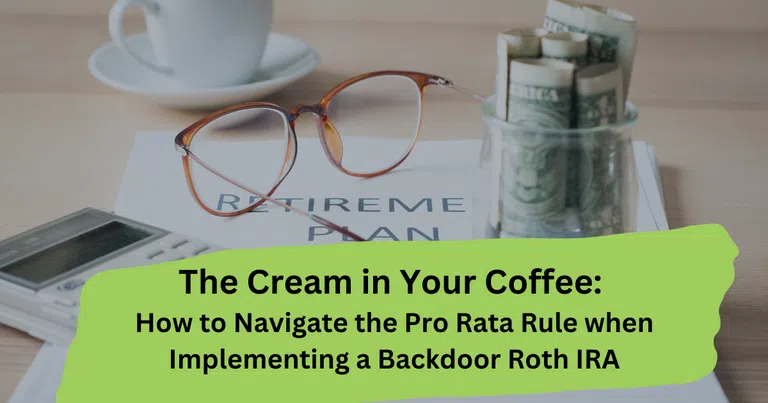
Navigating the Pro Rata Rule when Using a Backdoor Roth IRA

What is a Roth IRA? There are two ways that you can contribute to an IRA: post-tax and pre-tax. A Roth IRA allows you to pay taxes on your money now, invest that money, and never have to pay taxes on any of the gains from that investment. Therefore, your contributions are post-tax. Traditional IRAs on the other hand allow you to defer your taxes today by taking a tax deduction on the amount you invested into your account, invest that money, and then pay taxes on the distributions. These would be pre-tax contributions. Why should I choose a Roth IRA? Both the Traditional and the Roth should be looked at in your overall tax strategy. However, many people are of the opinion that it is better to pay the taxes now to decrease your risk of paying more taxes later. Taxes may rise in the future, or you may be in a higher tax bracket later in life. By paying the taxes upfront you are protected from any potential increases. Why can’t I use the front door? You can! If you are within the income limitation rules, then you can contribute directly to a Roth IRA. Here is a link to the most up to date IRS guidance on IRA contribution limits. For 2023  If you are a single filer your Modified Adjusted Gross Income (MAGI) must be below $138,000 to contribute the full $6,500 ($7,500 if you are 50 or over) to your IRA. If you are married filing jointly your MAGI must be below $218,000 to contribute the full $6,500 ($7,500 if you are 50 or over) per spouse to your IRA. As you can see if you are a high-income earner, you may not qualify to contribute directly to a Roth IRA. Your options are then to either contribute to a different type of retirement account, or use the Backdoor Roth Strategy. What is the backdoor? The backdoor is where you make a post-tax contribution to a Traditional IRA and convert those contributions into a Roth IRA. As of the writing of this article this is a known, widely used and accepted strategy for getting funds into a Roth IRA. However, it is not as straight forward as contributing directly to your Roth IRA and making a mistake could create unintended negative tax consequences. One of the most common pitfalls is not properly navigating the Pro-Rata rule also known as The Cream in the Coffee rule. The Cream in My Coffee? There are three components to the coffee with cream analogy. 1) the cup 2) the coffee 3) the cream. The Cup: The cup is the Traditional IRA account type. There are three different accounts that work as a Traditional IRA: the standard Traditional IRA, the SEP IRA, and the SIMPLE IRA. It is important that you realize that for the purposes of the Pro Rata rule the IRS is looking at all three of these accounts as one big cup rather than three separate cups. So, when you contribute to any one of these accounts it will be mixed with contents of the other two. The Coffee: The coffee is your pre-tax contributions. The Cream: The cream is your post-tax contributions. Okay… so what does that mean for me? What this means is that if you were to have pre-tax contributions in any Traditional IRA accounts and then were to make post-tax contributions all your contributions would now be mixed and you wouldn’t be able to separate them on distribution. Similar to how once you’ve added cream to your coffee you can’t just pour out the cream! Why is this an issue? Let’s take an example, you have $45,000 in pre-tax contributions in your Traditional IRA cup. You decide to use the backdoor to add $5,000 to your Roth IRA. So, you add $5,000 post-tax into your Traditional IRA and convert $5,000 of your traditional IRA to a Roth IRA. Oh no! You just caused yourself to have to pay taxes on 90% (45,000/50,000) of the $5,000 you converted into your Roth IRA. This is because you added the cream to your coffee it all got mixed and when you went to pour it out just the cream the coffee came out with it. What could have been done instead? A solution to this problem it to make sure that there is nothing in your cup when you go to add the cream! One way to do this would be to rollover all of your Traditional IRAs into a 401k. With these accounts now empty you can be sure that post-tax dollars will not mix with pre-tax dollars when added to your traditional IRA. Then when you convert to a Roth IRA only post-tax dollars will come out. This all sounds too complicated It sounds complicated because as with anything having to do with the US tax code… it is! If you’d like help with tax planning and implementation of a Backdoor Roth IRA let us know and we’ll help guide you through. While we’ve got you here, why not take a look at our CPA services. View Services View More Resources Disclaimer The content contained in this blog post is intended for general informational purposes only and is not meant to constitute legal, tax, accounting, or investment advice. You should consult a qualified legal or tax professional regarding your specific situation.

Navigating the Pro Rata Rule when Using a Backdoor Roth IRA Read More »

Quick Guide Estimated Income Tax

Quick Guide on Paying Estimated Income Tax

In the United States income taxes are to be paid on a regular basis throughout the year. As a self-employed individual you don’t have the luxury of your employer automatically deducting and remitting income taxes from your pay to the government. Instead, you must manage that process on your own. Below is a quick guide on how to do so. 

*Note – special rules may apply if you are a farmer or fisherman.

Quick Guide on Paying Estimated Income Tax Read More »

Scroll to Top

Contact

Connect